The first time you race away from home, everything is foreign. The water, the dock, the walk from the trailer, the parking, the hotel, the breakfast, the other teams with four trailers and matching everything. The temptation is to treat the whole weekend as an adventure and figure it out when you get there.
Don't. The crews that race well away from home are the ones who made the strange place familiar before they arrived, and then did exactly what they do at home. The routine is the one thing that travels. Everything in this post is about protecting it.
Know the weather before you pack
There is very little shelter at a regatta. You will spend the day outdoors, on grass or gravel, next to a trailer, exposed to whatever the day brings: freezing and wet, windy and miserable, baking hot, sometimes all three. Check the forecast for the venue, not for home, for every day you are away, and pack for the worst of it.
Every program loves to see its athletes in team gear from head to toe. What matters more is that you are warm and dry. Show up in team kit, and when it gets soaked, rotate through whatever keeps you warm, team gear or not. Two garbage bags in your backpack make the whole day work: one goes over the backpack at the trailer so everything inside stays dry; the other takes your wet clothes as you change out of them, so the soggy pile never touches the dry one.
Cold and wet: eat a little more than usual and get warm food and drink into you whenever you can. Hot: hydrate on a schedule, not on thirst. A good rule of thumb is three parts water to one part electrolyte drink across the day, so for every three bottles of water, one of Gatorade or similar.

The practice row.
Make the landmarks real.
Study the course before you see it
You do not want to arrive and have everything be new. Before you leave, sit with your boat and the coach's notes and learn the water: where the launch site is relative to the start and the finish, how long the row to the start will take, how far past the finish you row before you can turn. That is how you plan a proper warm-up and still arrive at the start on time, and how you cool down back to the dock like a professional rather than a tourist.
Pick your landmarks, a quarter, half, three quarters, two minutes out, the same way you would at home. The practice row is for making them real, for learning the current, the wind, the bridges and the traffic pattern, and for finding out how the dock works and how long it gives you. It is not for pieces.
Know the ground too. Where is the parking? Is there a shuttle? Where is the drop-off? Plenty of crews arrive to discover remote parking and a bus they didn't plan for. Know exactly how you are getting from your car to your trailer the night before, not the morning of. Someone drops a pin on the trailer and shares it with the team and the parents; someone from the parent association drops a pin on the tent.
Rig in pairs, launch with calm
Your coach will give each boat a time to be at the trailer. Be there early and find your crew. The bond in your boat is a direct input to your result, so the first job at the trailer is to be together. When the coach says rig, jump to it. Rig with your pair partner, rig your own seats, check each other's. Your seat is your responsibility. Don't arrive to find your teammates have rigged your boat for you; that conversation never goes well. When your seat is done, move down the boat and help.
Boats travel badly. After rigging, check your own foot stretcher, seat, tracks, oarlock and gate, then your partner's. The tool kit and spares live with the trailer; know where.
Carry the oars down yourself. The walk to the water is the walk you will take with the boat: does it have to spin, which path does it take, where are the marshals, where does the dock queue form. Hold that picture clearly before you lift, and you will launch calm and confident.
Everything takes longer
Everything at an away regatta takes longer than you think. The shuttle, the walk, the dock queue, finding the bathroom. Build fifteen minutes into every step. If the coach says be at the trailer at seven, that means ten to seven. The crews that panic at away regattas are rarely slow rowers; they are crews whose morning drifted ten minutes at a time until the warm-up was gone.
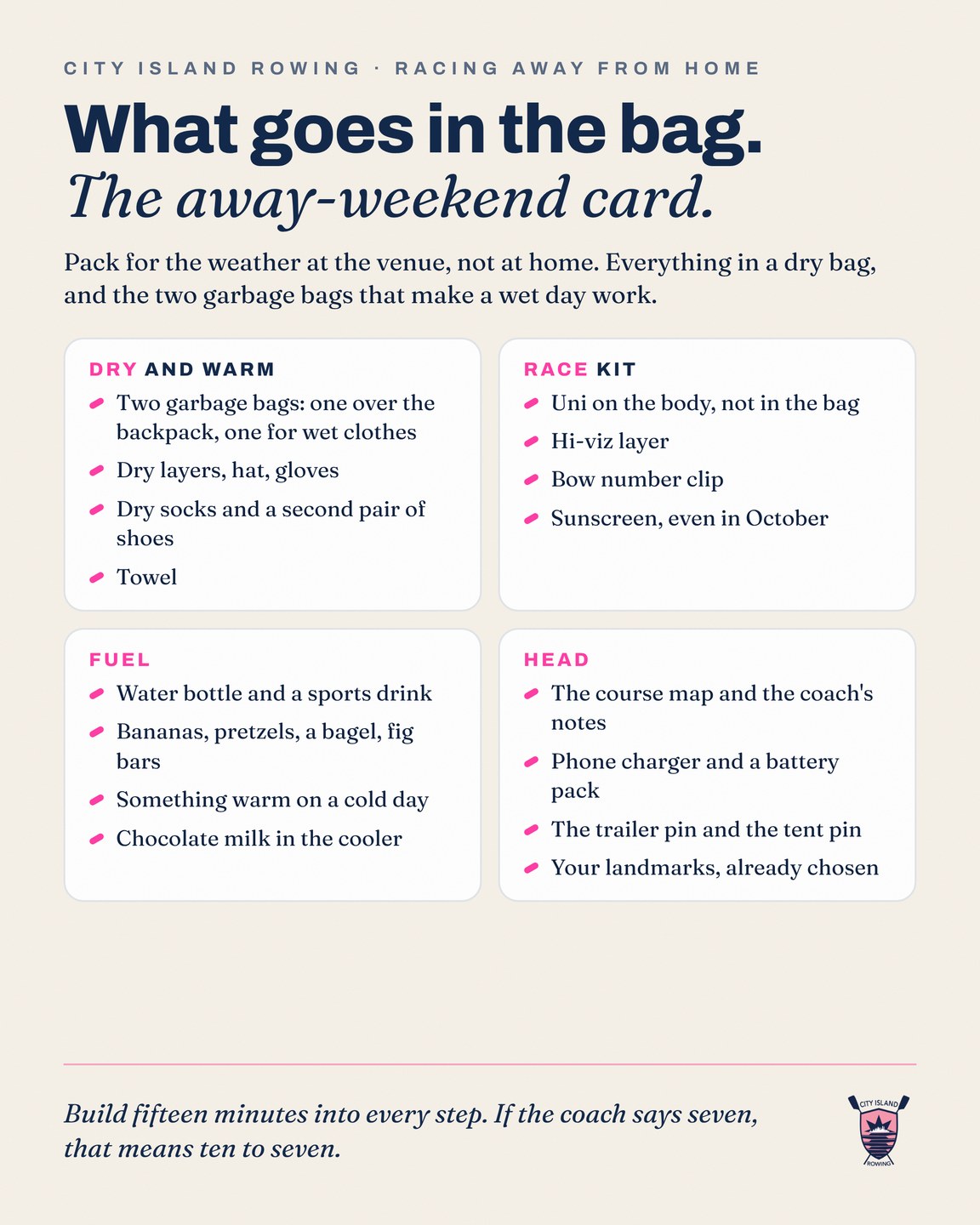
The away-weekend card.
Pack it the night before you leave.
The hotel
A hotel with your team is exciting, and for younger athletes it can feel like camp with fewer rules. That feeling is the enemy. Two things go wrong in hotels: fuel and sleep.
The hotel has every sugary thing you can imagine. Be disciplined. Eat the way you ate in Fueling Race Day, because nothing about the hotel changes what your body needs on race morning.
Then lights out. Every team sets a curfew, and in every team there is a room still talking at 11:30 because nobody noticed 9:30 go by. Your body needs the sleep. Professional athletes respect the curfew and protect their sleep, because the race does not begin at the start line. You are already racing.
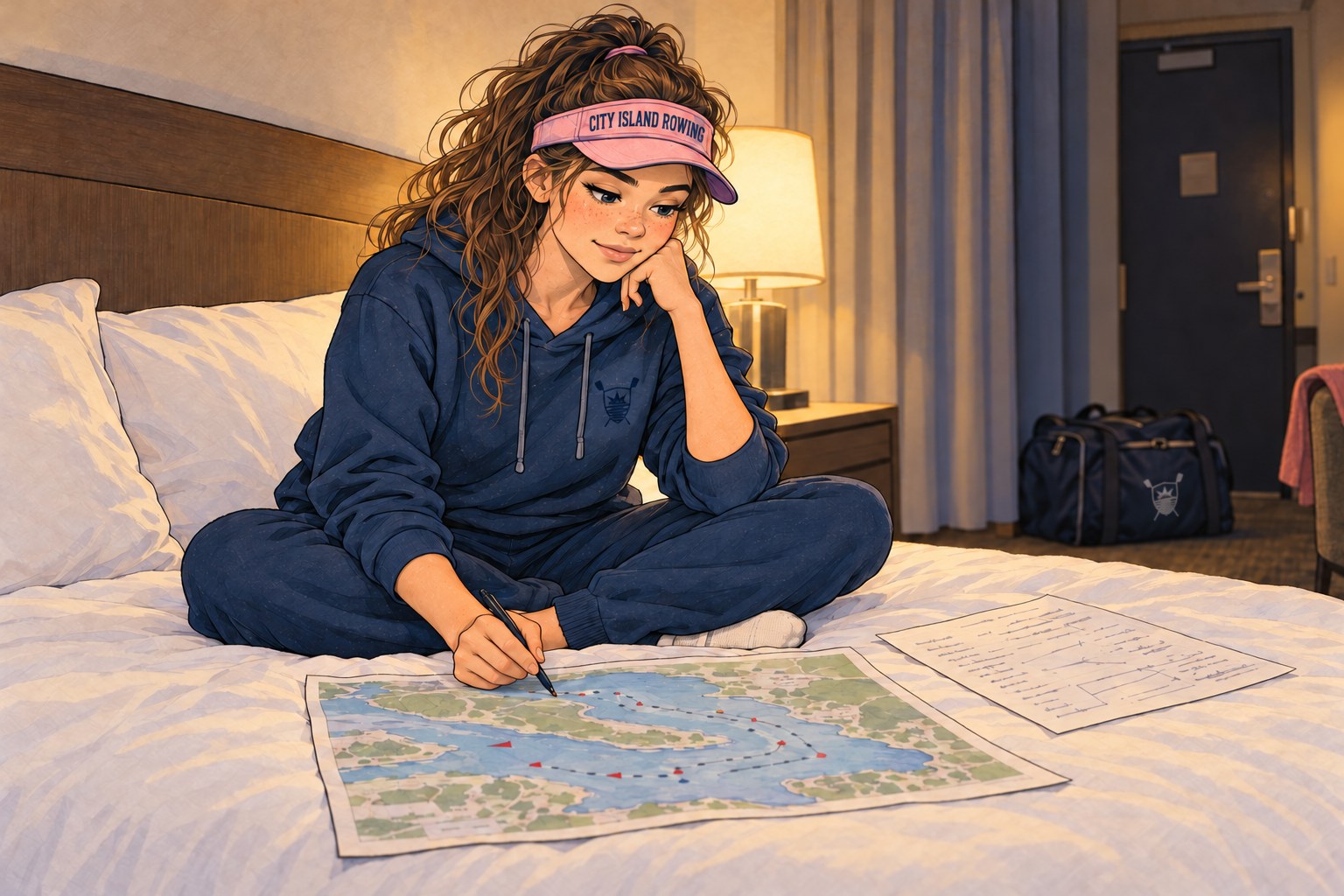
The hotel room is the best place on the whole trip to sit with your boat and your coxswain, open the coach's notes and the map, and make sure everyone sees the same race.
Race morning: if there is time to eat at the hotel, eat early, then go back to the room and lie down for half an hour. Never eat close to the start. Early breakfast and a nap beats a late breakfast every time.

The bus.
The venue is new. You are not.
The crowd, the names, the noise
Away regattas put you beside programs with more trailers, more coaches, more of everything. None of it rows their boat. Your routine is the one thing that travels, so keep it exactly the same as it is at home: same warm-up, same words, same landmarks, same twenty strokes when the voice says ease off. The venue is new. You are not.
Afterwards
Load the trailer with the same care you rigged with. Thank the hosts and the volunteers. If there is a second hotel night, it is a recovery night: food, water, feet up, sleep.
A word to parents
Your place at an away regatta is the parent association tent or the shoreline, and nowhere near the trailer. Not "don't crowd it." Stay away from it entirely. Stepping back from our trailer puts you in the way of someone else's, and the trailer area on race morning is boats on shoulders, oars, coaches and marshals, with no room for an audience.
Drop the pin on the tent so new families can find you. Keep the food and the dry clothes flowing. And keep to the coach's timeline, not your own; the schedule is the schedule, however excited you are. Cheer from the bank with everything you have. That is where you are useful.
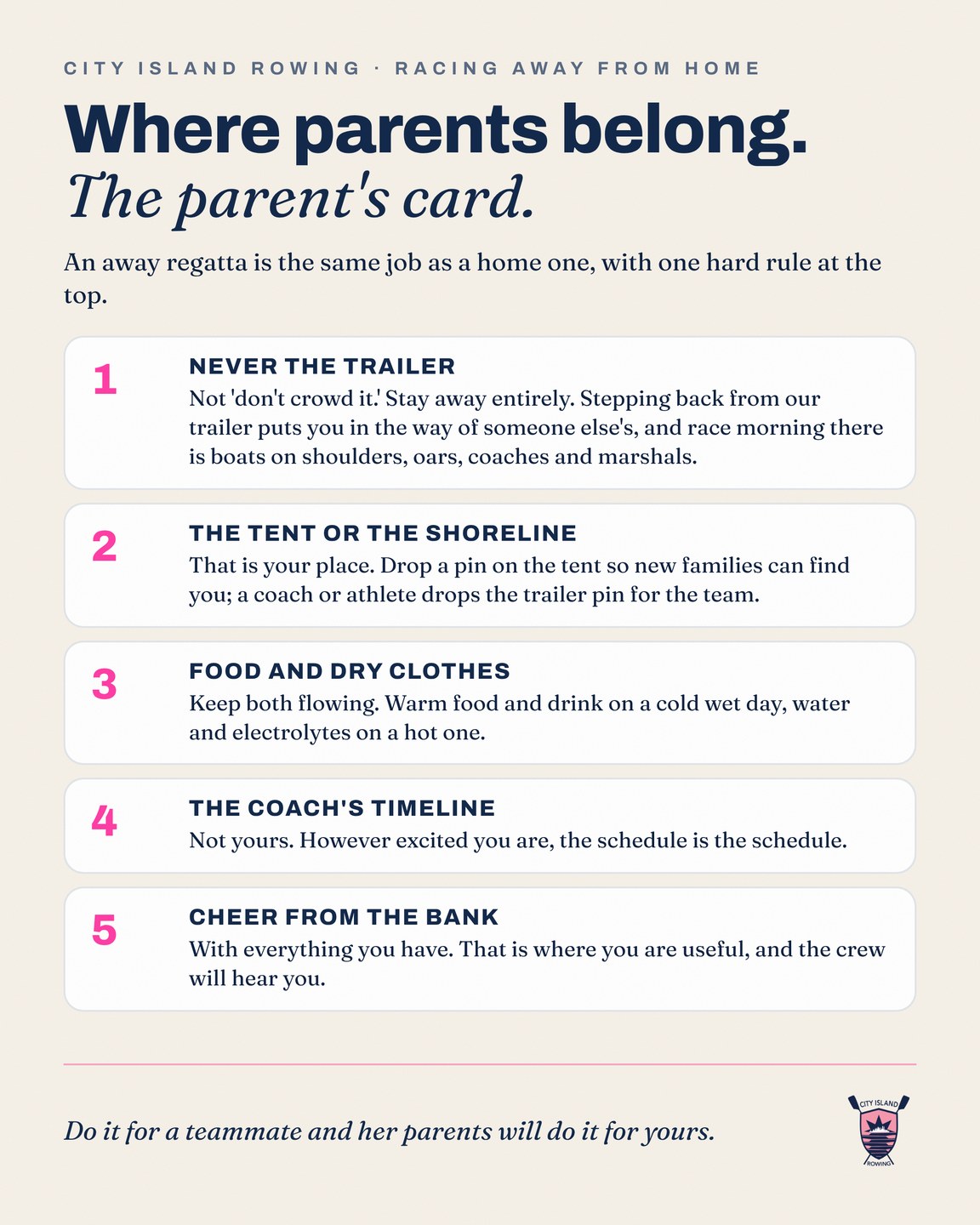
The parent's card.
The tent or the shoreline.
Pack for the weather at the venue, with two garbage bags. Learn the course, the parking and the walk before you leave home. Be at the trailer early, rig your own seat with your partner, carry the oars down yourself. Build fifteen minutes into everything. Eat like an athlete at the hotel and go to sleep when the lights go out. Then do exactly what you do at home.
The venue is new. You are not.