
Everything you eat from two nights before a race onward is in the boat with you. The last five hundred metres is the receipt. The rower who fades at the thousand is very rarely the one who trained least. She is the one who skipped breakfast, ate nothing between races, and reached for the trail mix an hour before the start because it looked healthy.
This is what the tank runs on, how to fill it, and what to put in the bag. Numbers are for a 130-pound rower; the card further down scales them to you.
Carbohydrate is the fuel
A head race is fifteen to twenty minutes at the limit, and that effort runs almost entirely on carbohydrate. Fat is fine for a walk; it cannot be burned fast enough to row at race pace. Carbohydrate is stored as glycogen in the muscles, which powers the stroke, and in the liver, which keeps blood sugar up so the brain stays sharp when the body wants to stop. The tank holds about a pound in total. It is not bottomless, and a race draws on it fast.
Carbohydrate does not make you fat, spike you or crash you at the amounts an athlete needs. It fuels the brain, powers training, refills the tank, and speeds recovery. A rower in a training week needs roughly 3 to 4.5 grams per pound of body weight per day. For 130 pounds that is 350 to 600 grams, and most teenagers eat well under half of it.
Race-day sources. White bagels, white bread, white rice, plain pasta, pretzels, rice cakes, bananas, applesauce pouches, dried fruit, honey, jam, low-fiber cereal, fruit juice, fig bars, plain crackers, a jam sandwich, a sports drink. A handful of gummy bears at the dock thirty minutes before the start is fuel, not a crime.
The wholegrain trap. Fiber, fat and protein slow digestion. On a training day that is a good thing. In the hours before a race it is the reason for the heavy stomach at the start. Bran cereal, a big salad, beans, a bag of nuts and wholegrain bread and pasta are the right food on the wrong day. The last two hours before a race are white bread hours.
Protein is the repair crew
Protein builds and repairs muscle, tendon, immune cells and hormones. It is not a race fuel; the body burns almost none of it to move a boat. Its job is in the twenty-four hours around racing and on every training day, which means it belongs in last night's dinner, in breakfast, and in the meal after the last race, not in the hour before the start.
A rower in training needs about 0.6 to 0.9 grams per pound per day, spread across three or four meals of 20 to 30 grams each. The body uses each dose as it arrives, so a huge dinner does not make up for a toast-only breakfast. Good sources: a palm-sized piece of chicken, turkey, lean beef or salmon; three eggs; a cup of Greek yogurt; a pint of milk; cottage cheese; tofu, lentils, chickpeas; a protein bar; peanut butter. Dairy before bed, a glass of milk or a yogurt, feeds the overnight repair.
Hydration, and the sports drink question
Performance drops once you have sweated out about two percent of your body weight, which is under three pounds for a 130-pound rower. In October you sweat less than in July, but a hoodie on a riverbank hides a lot, and a long day adds up. Sweat carries salt, so a long day needs some sodium, not only water.
Water is enough for anything under an hour. A sports drink adds nothing to a single early race except sugar. A sports drink earns its place on a multi-race day, over an hour of activity, or when the athlete has not managed to eat. Five to eight percent carbohydrate with electrolytes is the range; soda and neat juice are too strong and slow the stomach down. Nothing with caffeine on race morning, and no energy drinks at all.
Sip, don't gulp. The aim is to arrive at the start hydrated, not full. Steady intake through the morning is absorbed and used. A bottle thrown down in the marshalling area sits in the stomach, sloshes through the start and is partly lost before the finish. If you wait until you are thirsty, you are already behind.
Coconut water rehydrates as well as a sports drink and as well as water, with more potassium and less sodium than sweat replaces. It is a fine drink after racing if you like it. At volume before a race it bloats.
Chocolate milk is the best thing in the cooler for the end of the day. Four parts carbohydrate to one part protein, plus sodium, potassium, calcium and fluid, and the evidence in trained athletes says it matches or beats purpose-made recovery drinks. Eight to twelve ounces within half an hour of the last race. Not before a race; the fat and protein sit heavy.

After the last race.
The best thing in the cooler.
The timeline
Two nights before. A full dinner: your normal protein and plenty of carbohydrate. Carbohydrate stores take a day and a half to fill, so the tank starts filling here. Water through the evening.
The night before. Carbohydrate-led, protein modest, fat low: pasta with a tomato sauce and chicken, rice and fish, a baked potato with lean protein, bread on the side, vegetables. Not the first pasta of the season and not a buffet. Dessert is fine: fruit, sherbet, yogurt. Water through the evening, something with milk before bed, and eight hours of sleep. You are already racing.
Breakfast, three hours before the first race. The main meal of the day, light on fat and fiber: oatmeal with honey and banana, a bagel with jam, pancakes or waffles with syrup, low-fiber cereal with milk, toast and scrambled eggs, yogurt with granola. Aim for about 120 to 180 grams of carbohydrate; a bagel with jam, a banana, a glass of juice and a yogurt gets there. Ten to fourteen ounces of water with it. If the race is very early, eat smaller and earlier and top up on the way.
Between races, by the gap to the next start.
Three hours. A real refuel, carbohydrate-led, modest protein, low fat: a turkey sandwich on white bread, or a bowl of pasta or rice, a banana, a sports drink. Then nothing heavy; sip through the gap.
Two hours. A light meal or a big snack, quick to digest: a bagel with jam, a jam sandwich, pretzels and a banana, a fig bar and a sports drink. About 60 grams.
One hour. Small and simple, 25 to 40 grams: a banana, a handful of pretzels, a granola bar, an applesauce pouch, a few gummies, half a sports drink. Finish eating forty-five minutes before you boat.
Within thirty minutes of every finish, always. Easy carbohydrate immediately: sports drink, banana, cereal bar, sweets. Then something with salt. Then the meal that fits the gap. The rower who eats nothing between races because her stomach is nervous is the one who fades in race two. Small, bland, frequent is the answer, and a sports drink counts as food.
After the last race. Chocolate milk, then a proper meal within two hours. This is where the protein goes.
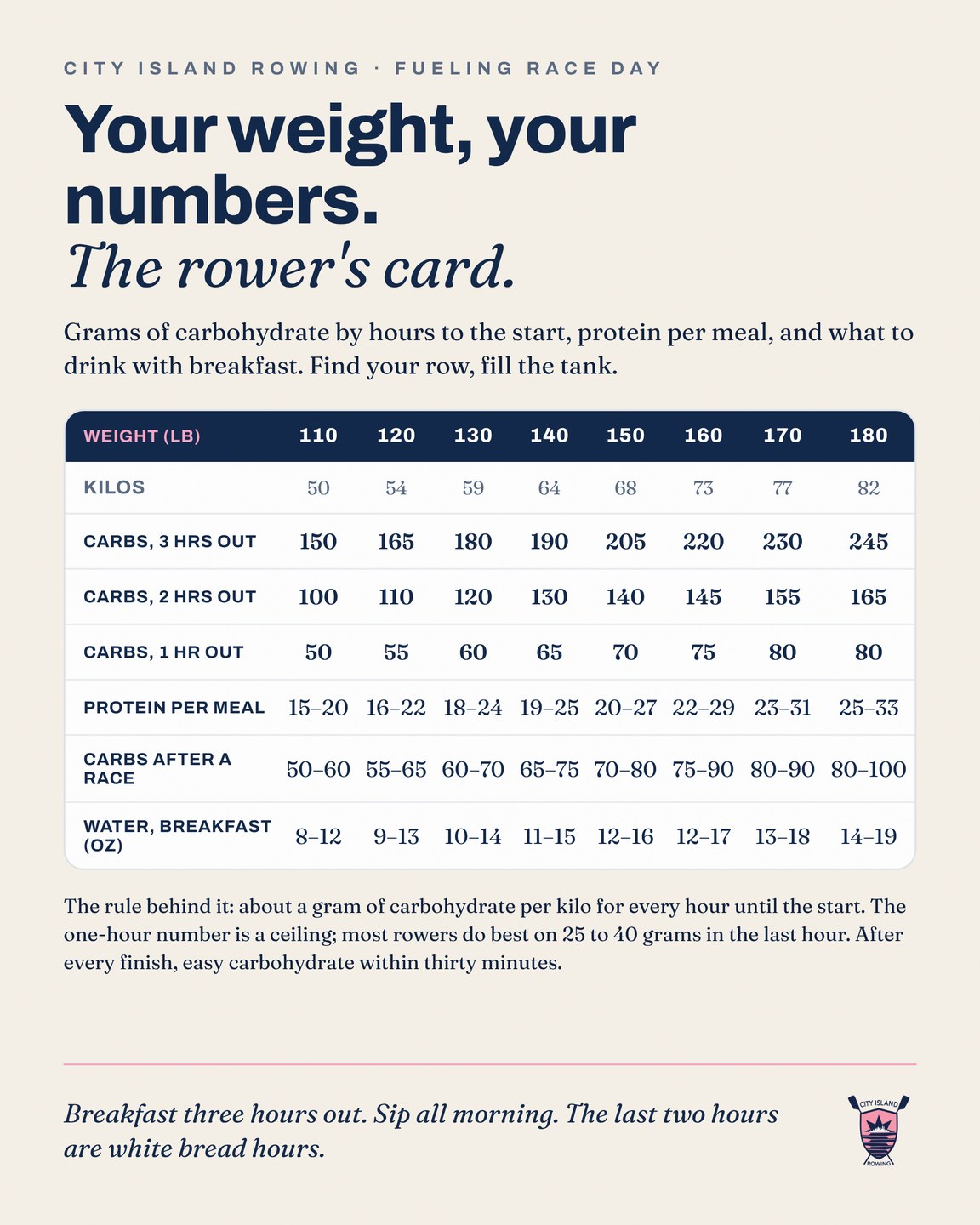
The rower's card.
Find your row.
What's in the bag
Water bottle. Sports drink. Bananas. Pretzels. A bagel in foil. Jam. Fig bars. Applesauce pouches. Dried fruit. Gummy bears. A sandwich. Chocolate milk in the cooler.
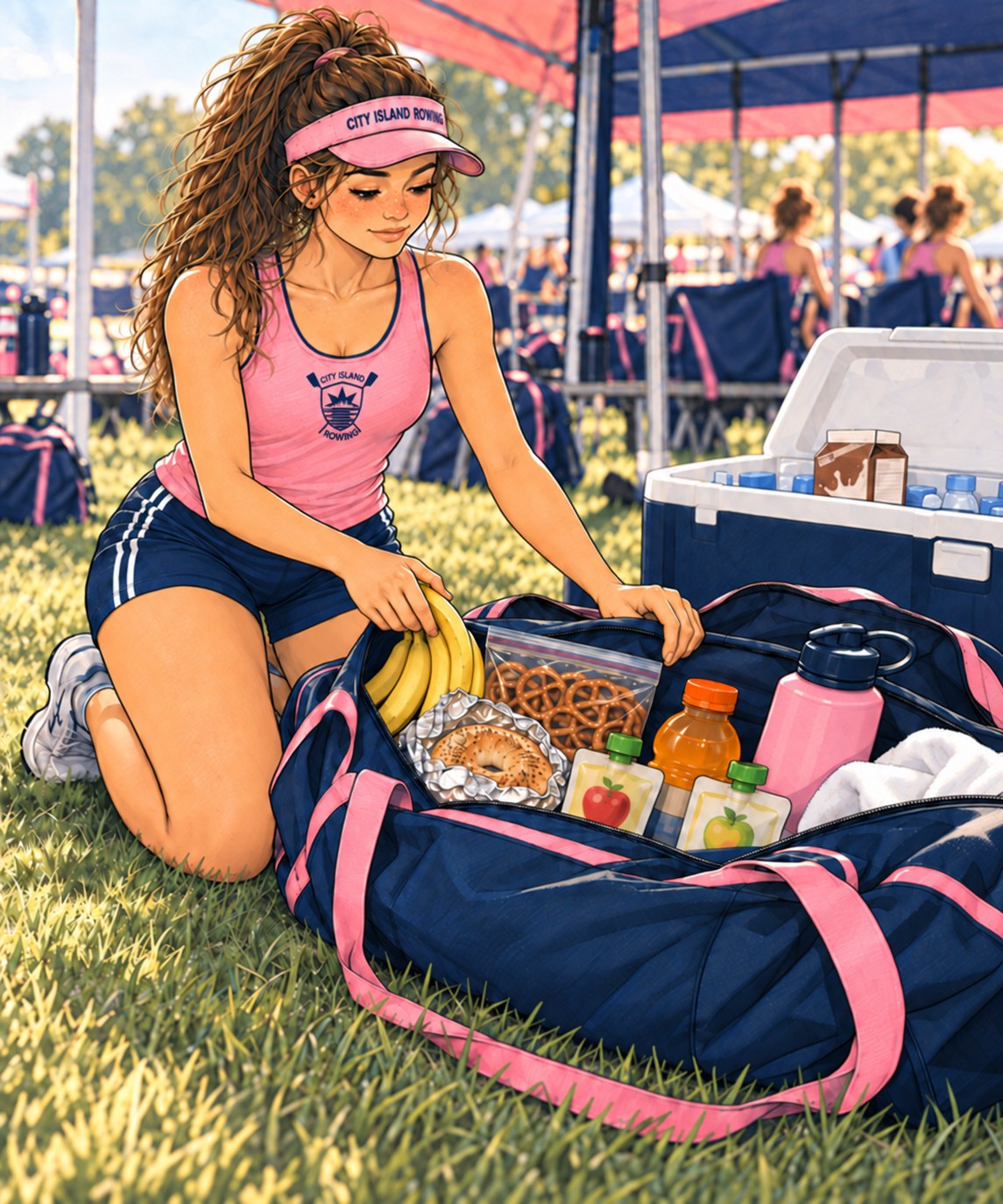
The bag.
Pack it the night before.
The tent
The rule is simple: before and between races, nothing high fat, high fiber, spicy or new. Everything on the "later" list is welcome after the last boat is on the trailer.
Put out: bagels and jam, bananas, pretzels, rice cakes, fig bars, granola bars, applesauce, oranges, grapes, white-bread sandwiches with turkey, ham or jam, plain pasta or rice salad with a little chicken, water, sports drink, and chocolate milk in the cooler for the end.
Later, with our blessing: the burgers, the pizza, the brownies, the hot chocolate.
Rather not, mid-day: fried food as the main offering, trail mix and nut bars as the snack, cheese-heavy anything, soda, energy drinks, and a new recipe nobody has tried. The regatta is not the place to discover a food intolerance.
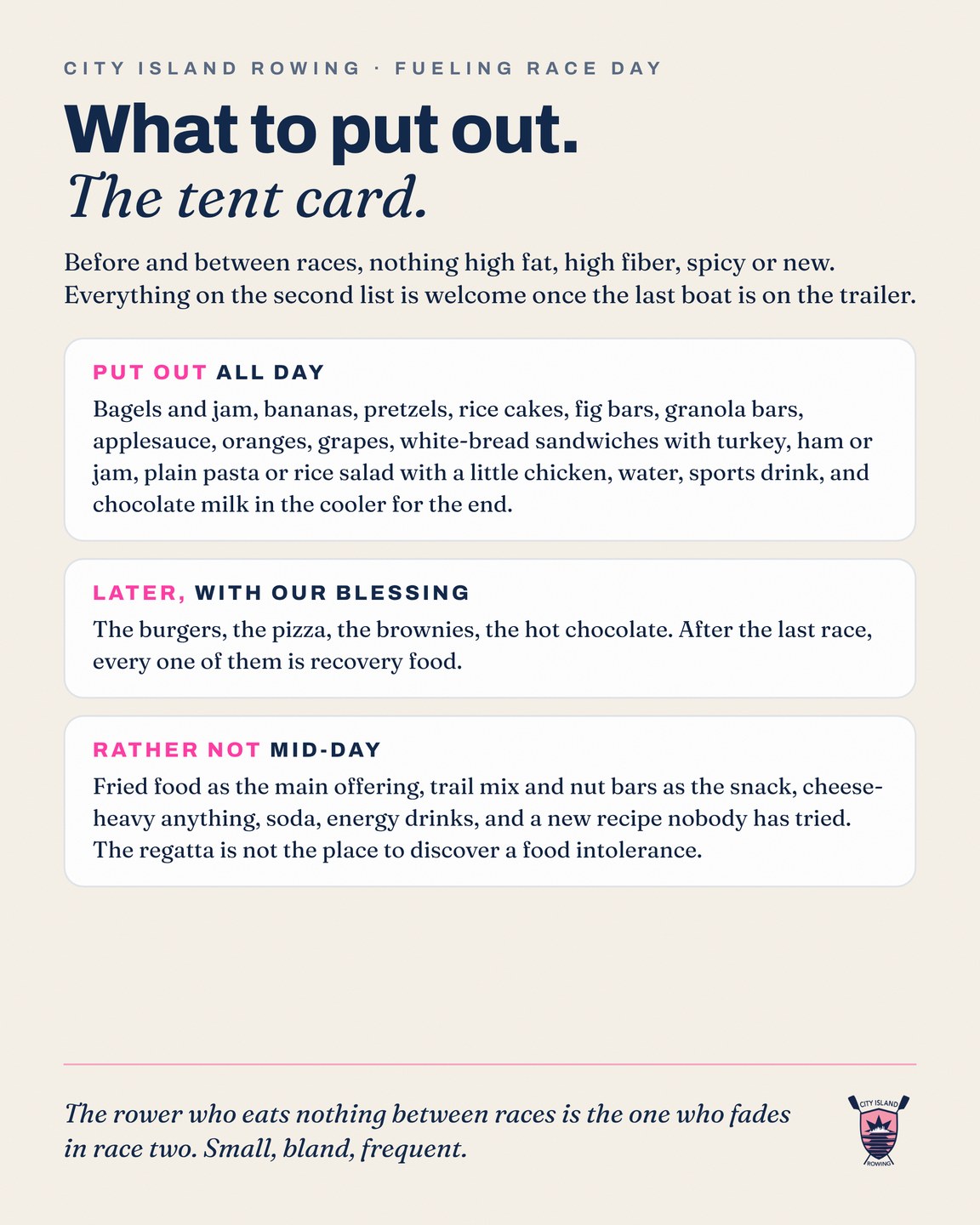
The tent card.
Print it for the cooler lid.
Fill the tank from two nights out. Breakfast three hours before the start, low fiber in the last two hours, sip all morning. Eat something within thirty minutes of every finish, size the next snack to the gap, and nothing new, fried or fibrous until the trailer is loaded. Chocolate milk at the end. The last five hundred metres is the receipt.
Eat like it matters. It does.