The Team Room · The CIR Playbook

Rowing recruits late — and that's your advantage

Everything we know about getting recruited to row in college — the honest version, from a program that does this every single year.

Why Rowing Is Different

The clock runs differently in this sport

In most sports, college rosters are filling years in advance. Rowing is not most sports. Rowers keep growing, and 2K scores keep dropping, right through high school — so college coaches won't commit early when a bigger, faster athlete may walk through the door next season. That's why most rowing offers land in senior year, with the serious conversations starting in the spring of junior year.

The exception: the very fastest juniors — think sub-7:30 on the 2K — get recruited early, and hard. For everyone else, the late clock is a gift. It means a girl who found this sport in 9th or 10th grade is on exactly the same timeline as one who started at twelve. Under current NCAA rules, Division I coaches can begin contacting rowers on June 15 after sophomore year, and official visits can begin August 1 before junior year — but the real action follows the timeline below.

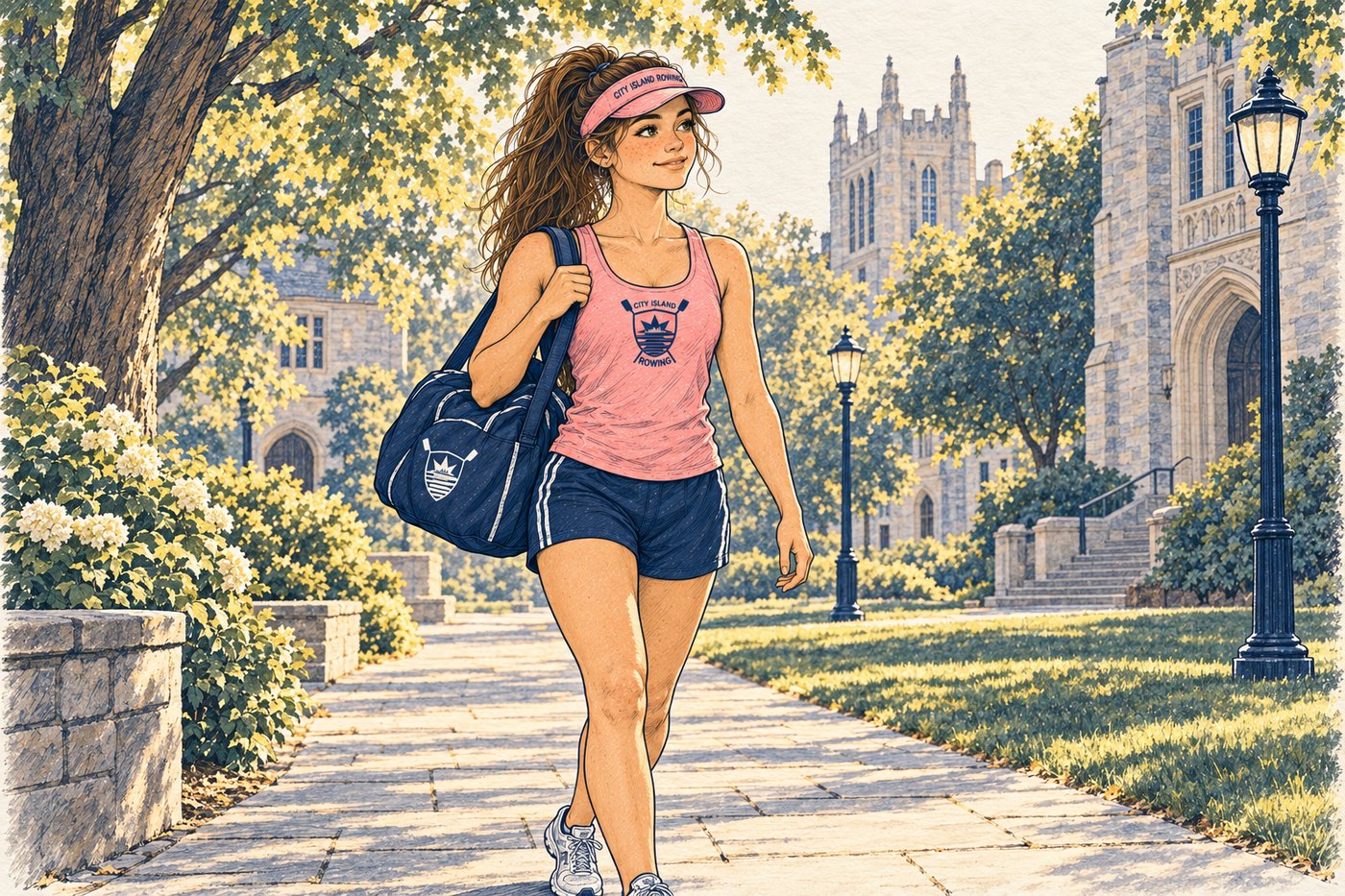
Illustration of a CIR athlete at her desk in the evening, writing introduction letters to college coaches on her laptop
The Centerpiece

The recruiting race, season by season

Think of it like a head race: a long warm-up, a committed start, a disciplined body, and a sprint at the end. Here is the whole course.

Illustration of a CIR athlete with her duffel bag walking up a leafy college campus path on an official visit
First Principles

The honest foundations

Choose a college you'd be happy at if you never rowed a stroke. Coaches change, injuries happen, priorities evolve. The school has to stand on its own.

Academics carry the day. Rowing opens doors, but grades walk you through them. Nobody turns professional in this sport — the degree is the payoff, and the discipline you built at 5:30 am is what employers are actually hiring.

And a level set: only a small number of athletes are recruited to the most selective programs each year. The goal isn't a jersey with a famous name on it — it's the right seat, in the right boathouse, at a school that fits.

Know the Flavor

D1, D2, D3 — the real differences

Division I is a job you love: up to 20 hours a week, serious erg volume, year-round commitment. Within D1, programs have wildly different personalities — find out the flavor before you fall for the letter.

Division II offers real racing with partial scholarships and, often, a saner weekly load.

Division III puts academics first — no athletic scholarships, but merit and need-based aid, and racing every bit as proud and rigorous. Some of the happiest college rowers we know chose D3 on purpose.

How to Choose

Three circles, one seat

Weigh every school through three lenses — in this order. The school you want lives where they overlap.

1 · ACADEMICS the school itself 2 · GEOGRAPHY & $ where, and what it costs 3 · ROWING the program — and Coach Guy's read on it HER SCHOOL
The Playbook

The moves that actually matter

Contacting a coach

Confident and humble, in that order. Know the school, know why you're writing to this program, and never send a form letter with the wrong mascot in it. Short beats long; specific beats glossy.

Know your numbers cold

Your 2K and 5K are your handshake. Know them to the second, at all times, because every conversation with a college coach starts there — and update your list the moment they improve.

Admissibility first

Before anyone falls in love, find out whether the academics work — coaches can run a pre-read of your transcript and scores. A hard truth in October beats a thin envelope in March.

Visits: official vs unofficial

Unofficials are yours to take anytime. Officials — the funded 48-hour weekend — are earned, limited, and evaluative in both directions. You are interviewing the whole time, including at breakfast.

The walk-on path is real

Squads of fifty-five recruit perhaps ten. Walk-ons fill the rest — and walk-ons have become national champions. Strong ergs earn mid-term scholarships at plenty of programs. Not recruited ≠ not rowing.

Registrations & resources

Register with the NCAA Eligibility Center before official visits. Browse every college program at row2k.com/teams.

For Parents

Your chapter — and it matters

The athlete contacts the coaches. Always. College coaches are recruiting a rower, not a family office — a parent-written email is the fastest way to move down a list. Your job is the one nobody else can do: steady support, good questions, and the occasional sanity check.

Install the Sunday check-in. Eight o'clock, Sunday night, fifteen minutes: where are we, what went out, what came back, what's next. Then — this is the important part — leave it alone for the rest of the week. A recruiting process discussed at every dinner burns everyone out by Thanksgiving.

Illustration of a CIR athlete and her mother at the kitchen table for the Sunday evening recruiting check-in, laptop open between them

Never overstate her interest — or her offers. The college rowing world is a small town, and coaches talk to each other constantly. A commitment exaggerated to one program will reach another by Friday.

And prepare, quietly, for the thin envelope. Most recruiting stories include at least one no. The families who handle it best treated every school on the list — including the safeties — as schools worth being excited about, because they were chosen that way.

Not a Solo Sport

Where Coach Guy comes in

You are never doing this alone, and neither is your daughter. When the five-school list is set, Coach Guy writes a strong personal recommendation to every coach on it — and here's what happens next: once that email lands, the college coaches almost always pick up the phone and call him. Those conversations are where doors quietly open. When spring season ends, he sends each program a season report on your athlete, and when she races Henley, he's on the bank making introductions.

And one standing instruction, stated plainly: if communication from a program goes quiet, say so. Coach Guy will reach out again — and a note from a head coach gets answered in a way that three weeks of a seventeen-year-old refreshing her inbox does not. That is what a small club buys you — a head coach who knows your daughter's name, her stroke, and her list.

Start the conversation

The best preparation is rowing well, right now

Recruiting is what happens to girls who stay in the sport and stay healthy. It's the payoff — not the reason to start.