Rowing has exactly one number that cannot be argued with, and it lives on the erg. Here's what the test is, what the numbers on the monitor mean, where our benchmarks sit, and a calculator to find yourself on the ladder.
An erg score is your time for a set distance on the Concept2 rowing machine: the 2k for high school athletes, the 1k for 7th and 8th graders. It is the sport's universal measuring stick, the same machine in every boathouse in the world.
The monitor gives you two ways of saying the same thing. Your time is the whole test. Your split is your pace per 500 meters, and it's how rowers actually talk: a "1:55 split" means every 500 meters is costing you 1 minute 55 seconds. Hold a 1:55 split for a 2k and you finish in 7:40. Time is the result; the split is how you lived.
Pick your grade, type your time, and the monitor does the rest: your split, your watts, your tier, and exactly how far to the next one.
Tiers assume you also row well and are in athletic shape. The machine measures the engine; the boat still has opinions.
For planning race pace and splits over any distance, the official Concept2 pace calculator is the gold standard.
Time and split for each tier. Under the time is in; the calculator above highlights your row.
| Speed at end of | Test | Elite | Very fast | Competitive | Developing | Enthusiast |
|---|---|---|---|---|---|---|
| 7th Grade | 1k | 4:00 · 2:00 | 4:10 · 2:05 | 4:25 · 2:12.5 | 4:40 · 2:20 | 5:00 · 2:30 |
| 8th Grade | 1k | 3:50 · 1:55 | 4:00 · 2:00 | 4:12 · 2:06 | 4:30 · 2:15 | 4:45 · 2:22.5 |
| Freshman | 2k | 7:45 · 1:56.2 | 7:55 · 1:58.7 | 8:15 · 2:03.8 | 8:30 · 2:07.5 | 9:00 · 2:15 |
| Sophomore | 2k | 7:35 · 1:53.7 | 7:47 · 1:56.7 | 7:55 · 1:58.7 | 8:20 · 2:05 | 8:45 · 2:11.3 |
| Junior | 2k | 7:25 · 1:51.2 | 7:35 · 1:53.7 | 7:45 · 1:56.2 | 8:10 · 2:02.5 | 8:35 · 2:08.8 |
| Senior | 2k | 7:15 · 1:48.7 | 7:25 · 1:51.2 | 7:37 · 1:54.2 | 8:00 · 2:00 | 8:25 · 2:06.3 |
Each cell reads time · split. "Under the time" means faster than it.
Junior National Team candidate. Recruiting offers from every program.
Assumes you also row very well, and that you are in athletic shape.
Nationally competitive athlete: crews should make A/B finals at Youth Nationals. Likely recruiting offers from most schools.
Regionally competitive. May qualify for Youth Nationals, likely C/D/E finals.
Recruiting offers mainly from DII and DIII schools, the occasional smaller DI if you row exceptionally well.
Competitive at smaller regional regattas, assuming you row well. Making finals at States or qualifying for Youth Nationals is a stretch at this speed, which is exactly why it's called developing.
Walk-on candidate to row in college; may be recruited by smaller programs.
Thoroughly enjoying rowing for the sport, the team spirit, and the exercise. Absolutely worthwhile.
Showing up and doing the work is the whole assignment. Every rower on this ladder started here.
Here is the trap, and it catches good athletes every year: the numbers at the top of that table look far away, so it feels safe to file erg speed under "later." A junior-year problem. Something you'll get to when it's time to think about college.
But the girls who post those numbers as juniors didn't jump there. They climbed a few seconds per season, starting in 8th grade, and by the time the number mattered it was already close. Wait, and the same table becomes a mountain: the gap that was two seconds a season is suddenly twenty-five in one winter, at exactly the moment coaches start watching.
So the job right now is small and boring: the program work, done fully, plus some fitness on your own time. On the erg or not. A run, the core circuit, anything that builds the engine: the go-to workouts are below. Chip away early and the climb stays smooth.
The erg matters because it cannot be argued with. It's the one purely objective number in the sport, it's the first question every college coach asks, and it's the honest record of the training you did when nobody was watching. It is also the number that answers only to you: nobody can pull it for you, and nobody can take it from you.
And then: ergs don't float. The machine measures the engine, but boats are moved by technique, timing, and eight people breathing together. That's why a lineup weighs the whole rower, and why the girl with the best split is not automatically in the best seat. Train the engine relentlessly. Then get in the boat and learn to spend it.
One more thing the erg won't tell you: coaches read scores weight-adjusted. Power per pound is a real measurement, every coach in the sport uses it, and it's why smaller rowers routinely move boats faster than their raw split suggests. If you're on the lighter side, your number is being read in context.
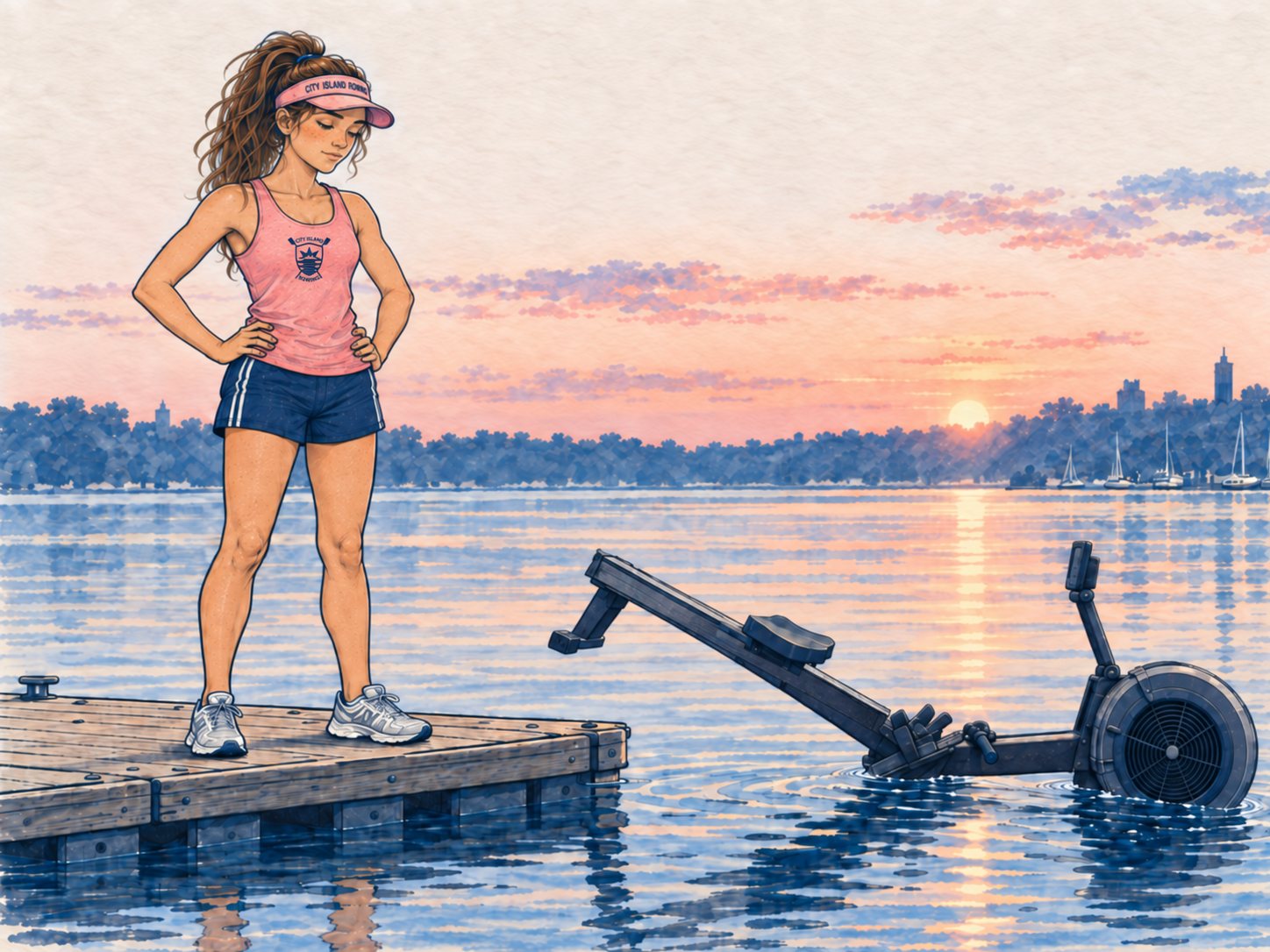
Sally confirms it: ergs don't float.
The benchmarks are built in the quiet weeks, not on test day. These are the standards: three for the erg at home, two for when there's no erg in sight.
The OYO itself: 2 × 20 minutes (U17) or 2 × 30 minutes (U19) at UT2, a pace where you could still hold a conversation. Rate 16 to 18, a few minutes easy between pieces. This is where the engine is actually built.
Four pieces at your 2k split plus 10, rate 24 to 26, two minutes rest between. Teaches your body what holding pace under fatigue feels like.
Alternate minutes, easy and hard: one at rate 16, then one hard, and the hard minute climbs each time through 26, 28, 30, 32. That's one round of eight minutes. Two minutes rest, then again: twice through for U17, three times for U19.
Running, biking, swimming laps, the elliptical, the stairmaster. 20 or 30 minutes at conversation pace. Same engine, different road.
The CIR core circuit, every day: once through for U16, twice for U17, three times for U19. No circuit handy? Three rounds: 45-second plank, 30 seconds per side plank, 15 squats, 10 lunges each leg, 15 supermans.
OYO workouts in season, erg season all winter, and the habits in the Blog. The benchmarks live on this page all year: come back after every test.